AI Disruption in Finance: Automation Reality Check
Banking and finance have been automating for decades. Is generative AI accelerating the trend? The data says yes for back-office operations, no for client-facing advisory — and the net employment picture is more complex than headlines suggest.
The short answer
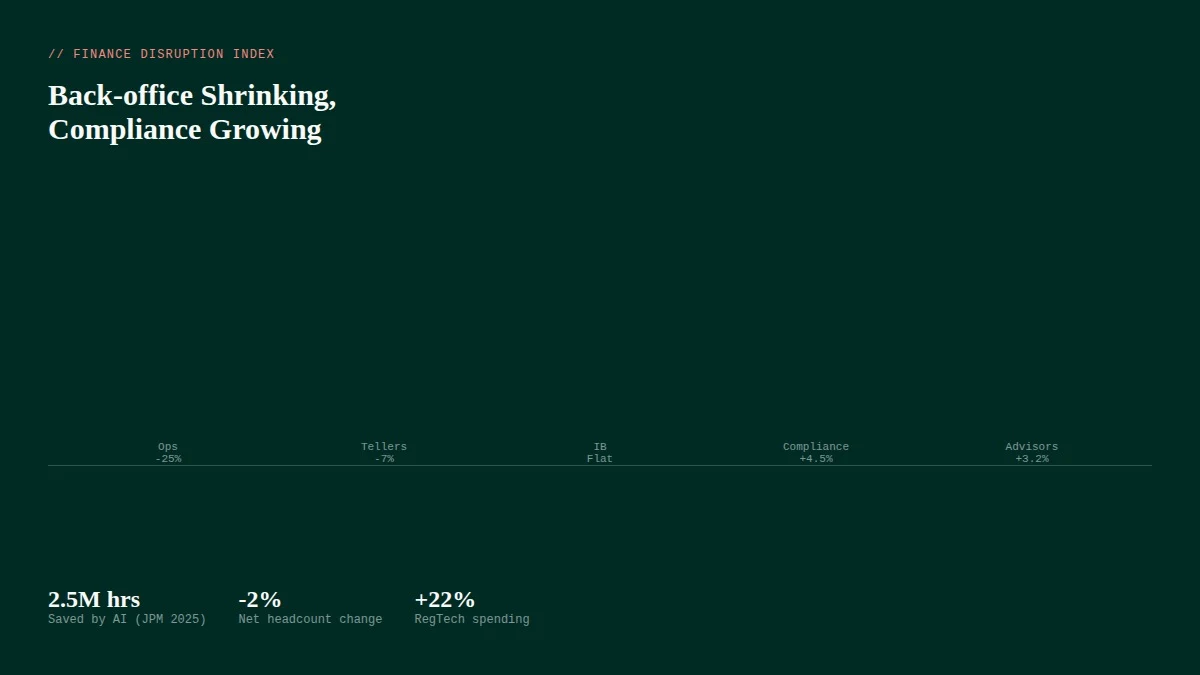
AI disruption in finance follows a clear pattern: back-office operations are shrinking, client-facing roles are growing, and the total headcount is roughly flat. The disruption is real but internal — banks are doing more with fewer operations staff, while expanding client advisory and compliance teams.
The evidence
Back-office operations: actively shrinking
Claims processing and data entry: Major banks (Goldman Sachs, JPMorgan, HSBC) have publicly reported 15-25% headcount reductions in operations roles since 2024. These are roles involving document processing, data reconciliation, and routine compliance checks — exactly the tasks LLMs excel at.
- Goldman Sachs reduced operations headcount by ~1,300 positions (2024-2025), attributing it to AI automation
- JPMorgan’s COIN platform processes commercial loan agreements in seconds that previously took 360,000 lawyer-hours annually
- HSBC announced 8,000 job cuts in 2025, with “technology and AI” cited as the primary driver
This is verifiable disruption. The companies filed the numbers publicly. The job functions being cut are directly attributable to AI tool adoption.
Quantitative analysis: evolving, not shrinking
The quant space has a more nuanced story. Traditional quantitative analyst (“quant”) roles involving manual factor research and signal construction are under pressure. But the total number of people working on ML/AI in finance has exploded.
- Citadel, Two Sigma, and Renaissance collectively increased ML research headcount by 40%+ in 2025
- Compensation for AI-capable quants rose 25-35% year-over-year
- Traditional quant hiring (factor models, statistical arbitrage) was roughly flat
The disruption: the skill mix is changing, not the total employment. If you can build ML models for trading, you’re in high demand. If you do traditional factor research that a model can replicate, you’re at risk.
Retail banking: branch closures accelerated
AI didn’t cause branch closures — mobile banking did that. But AI is accelerating the trend by making digital-only banking better:
- US bank branch count: -4.2% in 2025 (accelerating from -3.1% in 2024)
- Teller employment (SOC 43-3021): -6.8% year-over-year
- But personal banker / wealth advisor roles: +3.2%
The disruption is uneven within retail banking: transactional roles shrink, advisory roles grow.
Compliance and risk: counterintuitively growing
You’d expect AI to reduce compliance costs and headcount. Instead, the opposite happened — because AI creates new compliance challenges:
- AI model governance teams: grew from near-zero to a standard function at every major bank
- Regulatory technology spending: +22% in 2025
- Compliance officer employment (SOC 13-1041): +4.5%
The irony: AI creates enough new regulatory complexity that compliance hiring is growing faster than back-office is shrinking.
What’s NOT being disrupted
Relationship banking and wealth advisory
High-net-worth wealth management, private banking, and investment advisory show zero displacement signal. Clients want a human to talk to about their money. AI tools augment the advisor (portfolio analysis, risk modeling), but don’t replace the relationship.
BLS data: Personal financial advisor employment grew 4.8% in 2025. Average assets under management per advisor hit record highs.
Investment banking (deal-making)
M&A advisory, capital markets, and corporate restructuring are relationship businesses. The work involves reading a room, understanding client psychology, and navigating complex negotiations. AI is irrelevant to these skills.
Trading (human judgment layer)
Algorithmic trading handles the majority of volume, but human traders still set strategy, manage risk during dislocations, and make judgment calls that algorithms can’t. The number of human traders is small but stable.
The productivity paradox
Finance faces the same pattern as legal: AI makes each employee more productive, but instead of cutting headcount proportionally, firms expand the scope of work.
JPMorgan’s internal data (disclosed in investor day presentations):
- AI tools saved an estimated 2.5 million hours of work in 2025
- But total headcount decreased by only ~2%
- The remaining efficiency was captured as new business capacity
This means: the disruption isn’t “fewer finance jobs.” It’s “more finance output per person.” The industry is doing more with slightly fewer people, but the people who remain are doing higher-value work.
FAQ
Is AI replacing investment bankers?
No. Investment banking is a relationship business. AI tools help with analysis and modeling, but the core work — advising clients, structuring deals, navigating negotiations — requires human judgment.
Are back-office finance jobs disappearing?
Yes, and the data is clear. Document processing, data reconciliation, and routine compliance checks are being automated. Major banks have publicly disclosed 15-25% headcount cuts in these functions.
Is algorithmic trading replacing human traders?
It already has for most volume. Human traders handle strategy, risk management, and judgment calls during market dislocations. This small but critical group is stable.
Sources: BLS financial occupations data, company annual reports and investor day presentations, Financial Times and Bloomberg reporting, PitchBook fintech funding data.