AI Disruption in Healthcare: Separating Hype from Evidence
Healthcare was supposed to be transformed by AI. Two years of data show the transformation is real in diagnostics and admin, but patient-facing roles are untouched. The disruption is back-office, not clinical.
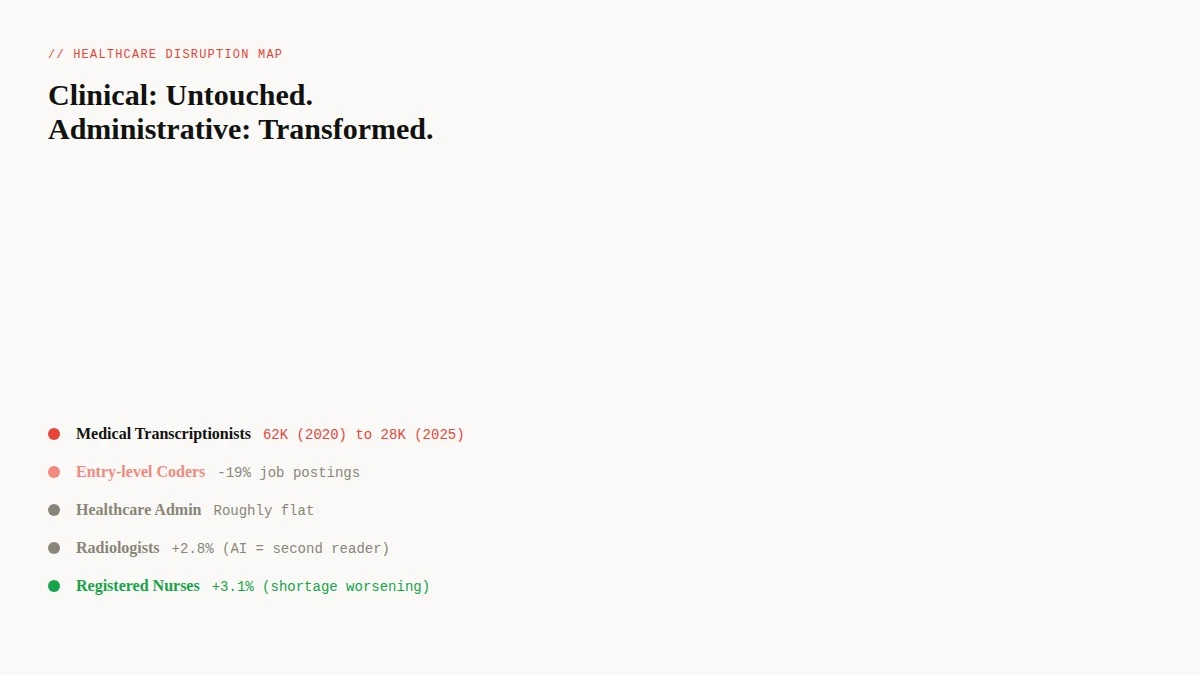
The short answer
AI disruption in healthcare follows the same pattern as other industries: administrative and analytical work is being automated, while hands-on clinical care is completely unaffected. The most significant disruption is in medical billing and coding — not in diagnosis, surgery, or patient care.
The evidence
Medical billing and coding: genuinely disrupted
Medical coding (translating diagnoses and procedures into billing codes) is a high-volume, rule-based task — exactly what AI handles well.
- AAPC (American Academy of Professional Coders) reports a 19% decline in entry-level coding job postings
- Major health systems (HCA Healthcare, Mayo Clinic) have deployed AI-assisted coding tools (3M M*Modal, Nuance)
- Revenue cycle management companies report 30-40% productivity gains per coder
The coding profession is restructuring: fewer entry-level coders, but senior coders who manage AI systems are in high demand. The American Health Information Management Association (AHIMA) projects the coding workforce will shrink 10-15% by 2028.
Medical transcription: essentially gone
This is one of the few near-total displacements. Medical transcriptionist employment (BLS SOC 31-9094):
- 2020: 62,000 employed
- 2025: 28,000 employed
- Projected 2028: under 15,000
AI-powered clinical documentation tools (Nuance DAX, Abridge, Suki) capture physician notes automatically. The transcriptionist role is nearly extinct — replaced not by AI alone, but by ambient clinical documentation tools.
Radiology: augmented, not replaced
Radiology was the headline “AI will replace doctors” story. The reality:
- AI tools now handle initial screening for certain conditions (breast cancer, lung nodules, diabetic retinopathy) with accuracy comparable to radiologists in FDA-cleared studies
- But radiologist employment (BLS SOC 29-2034) grew 2.8% from 2023 to 2025
- AI serves as a “second reader” that flags areas for human review
Why no displacement: Regulatory frameworks require physician sign-off. Insurance reimbursement requires physician involvement. Liability frameworks hold the doctor responsible, not the algorithm. AI makes radiologists faster (more studies per day), but doesn’t replace them.
Nursing and clinical staff: zero displacement
BLS data: Registered nurse employment grew 3.1% from 2023 to 2025. AI cannot perform physical assessments, administer medications, provide emotional support, or respond to clinical emergencies. The nursing shortage is getting worse, not better — AI has zero impact on it.
Administrative workflows: quietly automated
The biggest healthcare AI disruption is invisible to patients:
- Prior authorization: AI tools now auto-generate prior auth requests (CoverMyMeds, Olive AI), reducing administrative time by 40-60%
- Claims denial management: AI predicts and prevents denials before submission
- Scheduling and triage: AI chatbots handle patient scheduling at major health systems
These improvements reduce administrative overhead — but the savings are captured as margin improvement, not headcount reduction. Healthcare administration employment is roughly flat.
The investment landscape
Healthcare AI is the single largest vertical for AI venture funding:
- 2024: $11.2B invested across 480+ deals
- 2025: $18.6B invested across 620+ deals (preliminary)
- Hims & Hers, Teladoc, and other telehealth companies are pivoting to AI-first models
- FDA-cleared AI/ML medical devices: 950+ as of early 2026 (up from 692 in 2023)
The capital signal: investors believe AI will transform healthcare. But the employment signal says the transformation is concentrated in documentation, coding, and administration — not in clinical care.
Why healthcare is slower to disrupt than other industries
Three structural barriers:
1. Regulation. The FDA, HIPAA, state medical boards, and insurance reimbursement rules all require human accountability. Even when AI is more accurate, regulatory frameworks mandate physician involvement.
2. Liability. When a misdiagnosis harms a patient, someone must be legally responsible. That “someone” must be a human — a doctor, not an algorithm vendor. Until liability frameworks evolve, AI can augment but not replace.
3. Patient trust. Patients want to talk to a human doctor. Even if an AI provides a more accurate diagnosis, patients won’t accept it without a human intermediary. This is a preference, not a technology problem — and preferences change slowly.
FAQ
Will AI replace doctors?
The data says no. Physician employment is growing. AI is being used as a decision support tool — it flags findings, generates documentation, and speeds up workflows — but the regulatory, liability, and trust barriers prevent outright replacement.
What healthcare jobs are most at risk from AI?
Medical transcription (already nearly gone), entry-level medical coding (shrinking), and routine claims processing (being automated). All are administrative functions, not clinical.
Is AI improving healthcare quality?
In specific areas — early cancer detection, diabetic retinopathy screening, medication interaction checking — the evidence is positive. In administrative workflows, AI is reducing errors and speeding up prior authorizations. The quality improvement is real but incremental, not transformative.
Sources: BLS healthcare occupational data, FDA AI/ML-enabled device database, AAPC and AHIMA workforce reports, KLAS Research healthcare AI adoption surveys, venture funding data from Rock Health and PitchBook.